
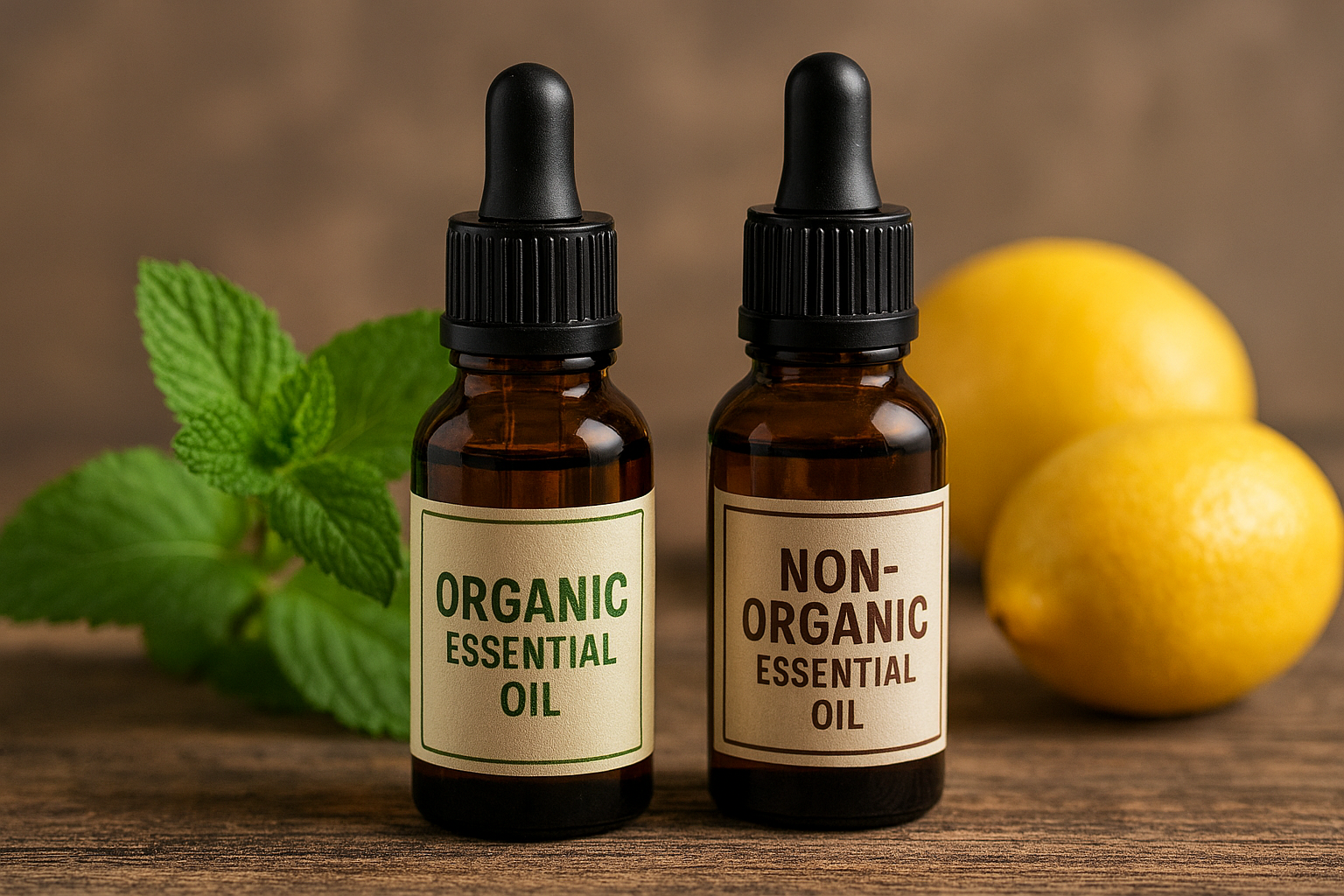
Have you ever picked up two bottles of the same essential oil and wondered why one says organic while the other does not? It is a common question, especially when you are trying to buy better-quality oils for aromatherapy, skincare making or natural living.
The confusion is understandable. “Organic” often sounds like it should mean cleaner, safer or more effective. But with essential oils, the difference is not always as simple as organic equals better and non-organic equals poor quality. The real answer comes down to how the plant was grown, how the oil was processed, and whether the product has credible certification behind it. Organic certification is a formal process tied to specific standards rather than just a marketing phrase.
If you are comparing oils for personal use or formulations, understanding those distinctions can help you make a smarter choice. Below, you will learn what organic and non-organic essential oils actually mean, where the differences matter most, and how to read beyond the label.
Table of contents
- What makes an essential oil organic?
- What is a non-organic essential oil?
- Organic vs non-organic: the key differences at a glance
- Does organic mean higher quality?
- Why rosemary essential oil is a good example
- How to choose the right oil for your needs
What makes an essential oil organic?
An organic essential oil comes from plant material that has been grown and processed according to recognised organic standards. In simple terms, that usually means the crop was produced without the routine use of synthetic pesticides, herbicides, genetically modified organisms and certain artificial fertilisers, and that the supply chain has been certified accordingly.
For essential oils, this matters because the “organic” claim should relate to more than the plant alone. It should also reflect traceability and certification through production and handling. That is why a proper certification logo or statement is usually more meaningful than a vague front-label claim. In Australia and other markets, certification standards exist, but consumer understanding can still lag behind the label itself.
A few things to look for:
- A recognised certifier on the label.
- Clear botanical naming.
- Country of origin or sourcing details.
- Batch or traceability information where available.
If you are specifically looking for a certified organic option, products such as organic rosemary essential oil can make it easier to compare like for like instead of relying on packaging language alone.
What is a non-organic essential oil?
A non-organic essential oil simply means the plant was not certified under organic standards. That does not automatically mean the oil is synthetic, diluted or low grade.
In many cases, non-organic essential oils are still pure essential oils obtained by steam distillation or another recognised extraction method. The difference is that the crop may have been grown using conventional agricultural methods, or the producer may not have pursued organic certification even if some farming practices were relatively clean. Certification can be expensive and complex, particularly for smaller growers.
This is where many buyers get tripped up. “Non-organic” is not the same as “fake”. It simply means the organic standard has not been certified for that product.
Organic vs non-organic: the key differences at a glance
| Factor | Organic essential oils | Non-organic essential oils |
| Farming method | Produced under certified organic standards | Usually grown using conventional farming methods or without certification |
| Certification | Requires formal certification and documentation | No organic certification attached |
| Pesticide rules | Synthetic pesticides and fertilisers are restricted or excluded under standards | Conventional inputs may be used depending on farming practice |
| Price | Often higher due to certification and supply chain controls | Often more affordable |
| Availability | Can be more limited for some botanicals | Usually easier to source |
| Quality | Can be excellent, but not automatically superior | Can also be excellent if well sourced and tested |
This distinction is important because quality and organic status are related, but they are not identical. A well-sourced non-organic oil may outperform a poorly handled organic one in aroma, freshness or suitability for your intended use.
Does organic mean higher quality?
Not always.
Organic certification tells you something important about how the plant was grown and handled, but it does not guarantee that the oil will smell better, perform better or suit your purpose better. Essential oil quality is also shaped by:
- Plant species.
- Chemotype.
- Soil and climate.
- Harvest timing.
- Distillation method.
- Storage conditions.
Research on rosemary essential oil shows that its composition can vary widely, with major constituents often including 1,8-cineole, camphor, alpha-pinene and verbenone depending on origin and chemotype. In other words, two rosemary oils can both be genuine and yet smell different or be preferred for different uses.
That is why it helps to think of organic as one quality marker rather than the only one.
A useful way to frame it is this:
- Organic tells you more about the farming and certification pathway.
- Quality tells you more about the oil’s identity, purity and production standards.
Why rosemary essential oil is a good example
Rosemary is a great oil for understanding this topic because it is not a one-size-fits-all ingredient. Rosemary essential oil is known for having different chemotypes, especially 1,8-cineole, camphor and verbenone. Those natural variations can influence aroma profile and how the oil is commonly selected in aromatherapy or formulation work.
That means when you compare an organic rosemary oil with a non-organic one, you are not just comparing farming method. You may also be comparing:
- Different growing regions.
- Different harvest periods.
- Different dominant aromatic compounds.
- Different intended applications.
So if you are choosing rosemary oil, it helps to look beyond the word organic and ask better questions:
- Is the botanical name clearly listed?
- Is the oil pure and properly identified?
- Is there batch transparency?
- Is the origin relevant to the profile you want?
- Is certification important for your personal values or formulation requirements?
For many buyers, organic rosemary oil makes sense because it aligns with a preference for certified sourcing standards. For others, a non-organic rosemary oil may still be the right fit if purity, aroma profile and intended use are the main priorities.
How to choose the right oil for your needs
The best choice depends on what matters most to you.
Choose organic if:
- You want certified sourcing standards.
- You are trying to reduce exposure to conventionally farmed inputs.
- You are formulating for a brand or product line where certification matters.
- You value traceability and certification logos.
Choose non-organic if:
- You are comfortable with a well-sourced pure oil without organic certification.
- You need a more budget-friendly option.
- You are focused on aroma profile, chemotype or batch data first.
- The botanical you want is harder to find as certified organic.
Either way, check for these green flags
- Full botanical name.
- Extraction method.
- Country of origin.
- Batch details where possible.
- Clear purity information.
- Realistic pricing.
Pricing matters more than many people realise. Suppliers and educators often point out that suspiciously low prices can be a warning sign, because essential oil yields and production costs vary significantly between plants.
The label matters, but context matters more
Organic and non-organic essential oils are not opposites in the way many people assume. One is not automatically good and the other bad. Organic tells you that the oil meets certified standards for how the plant was grown and handled. Non-organic tells you that certification is absent, not necessarily that the oil lacks purity or value.
The better question is not “Which one is best?” but “Which one is best for your purpose?”
If certification, traceability and farming practices are high on your list, organic may be the better fit. If you are comparing by aroma, chemotype and practical use, a high-quality non-organic oil may suit you just as well. The smartest buyers read the label, understand the source, and choose based on the full picture rather than a single word on the bottle.


